Posted on October 28, 2017 by abyssum

Italian Liturgist Alleged to be Working on Ecumenical Mass: “Transubstantiation is Not a Dogma”
 Steve Skojec, October 28, 2017.
In his Monday column at First Things, Italian journalist and veteran Vatican-watcher Marco Tosatti gave voice to what had previously been little more than a whispered rumor: that a group was at work, with Vatican knowledge and support, on a kind of interfaith liturgy:
[T]here is the matter of the “Ecumenical Mass,” a liturgy designed to unite Catholics and Protestants around the Holy Table. Though never officially announced, a committee reporting directly to Pope Francis has been working on this liturgy for some time. Certainly this topic is within the jurisdiction of the Congregation for Divine Worship, but Cardinal Sarah has not officially been informed of the committee’s existence. According to good sources, Sarah’s secretary, Arthur Roche—who holds positions opposite to those of Benedict XVI and Sarah—is involved, as is Piero Marini, the right-hand man of Monsignor Bugnini, author of such noted works as La Chiesa in Iran and Novus Ordo Missae.
Today, at his blog, Stilum Curae, Marco provides a bit more information on this story:
I cannot help recalling a comment sent to me by a friend, even though it was made several months ago. It was made by a highly regarded unrestrained lay liturgist, Andrea Grillo, who is, according to what they tell me, involved in the work to create an ecumenical Mass.
The comment is:
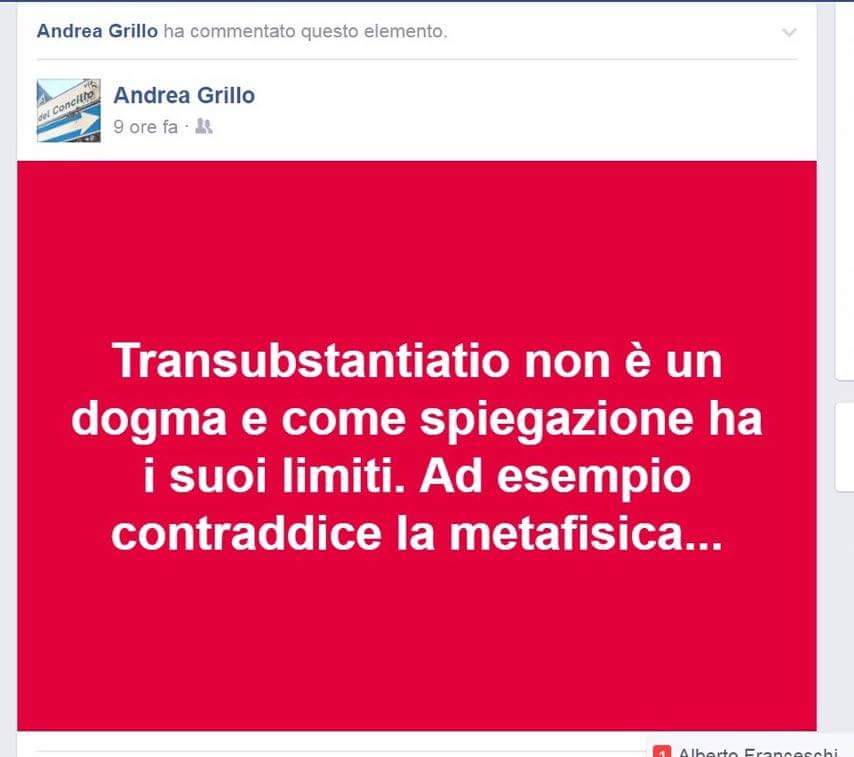
“Transubstantiation is not a dogma, and as an explanation [of the Eucharist] it has its limits. For example, it contradicts metaphysics.” [emphasis added]
I would like to understand then: have all those people who during the last two millennia have thought that in the host and in the wine [sic] there was truly the substance of the Body and Blood of Jesus – and those who still believe this now – have they been taken for a ride [by the Church]? Or, in a more benign hypothesis, were they victims of a false belief (to say nothing of Eucharistic miracles)? We are waiting with impatience to see where the work on the new ecumenical Mass will go, in order to go and put ourselves in line [for communion] at the closest Orthodox Church.
Grillo’s comments about Transubstantiation appeared on his Facebook page:
The Council of Trent, Session 13, Chapter VIII, says:
“If any one saith, that, in the sacred and holy sacrament of the Eucharist, the substance of the bread and wine remains conjointly with the body and blood of our Lord Jesus Christ, and denieth that wonderful and singular conversion of the whole substance of the bread into the Body, and of the whole substance of the wine into the Blood-the species Only of the bread and wine remaining-which conversion indeed the Catholic Church most aptly calls Transubstantiation; let him be anathema.”
I reached out to Marco Tosatti this morning, and he told me that Andrea Grillo is a layman who teaches sacramental and liturgical theology at the Pontifical Athenaeum San Anselmo in Rome. Tosatti told me that Grillo has recently attacked both Cardinals Caffarra and Sarah, “more or less asking Sarah to be dismissed from his position.” Tosatti’s sources have indicated that Grillo is a member of the secret commission to prepare this alleged “ecumenical liturgy,” which would allow Catholics and Protestants to “share the table.” Grillo is said to be influential in Rome, and to have the ear of the pope.
Grillo is also noteworthy for his opposition to Summorum Pontificum, and has written a book entitled, Beyond Pius V: Conflicting Interpretations of the Liturgical Reform, which was reviewed by the eminent liturgical theologian and author Dom Alcuin Reid, who he called it “a theological and political ‘shot across the bow’”. Reid also describes
Grillo’s fundamental stance that one must accept “the” liturgical reform absolutely and to the exclusion of all that came before (and of course, to the exclusion of any possible “reform of the reform”—which is dismissed out of hand)…
If he is indeed involved in the preparation of a new liturgy, one is left to wonder if this same attitude of liturgical evolution with no looking back will be pervasive in its implementation, too.
The Handwriting on the Wall
With no substantial confirmation of this secret liturgical commission’s existence, some will no doubt be skeptical of its plausibility. And yet there is not a little evidence that the Vatican under its current leadership might support such an effort. The pope and his associates had already been making overtures in this direction beginning in 2015, which I outlined at some length in my December, 2016 article, “Up Next on the Vatican Agenda: Intercommunion“. At the time, it had appeared that the goal was to allow Protestants to receive communion in Catholic churches. But an interfaith liturgy would take things quite a bit further, and would, it seems, be not entirely unthinkable in light of the Vatican’s own joint celebrations with the Lutheran churches marking the 500th anniversary of the Reformation, which will reach their culmination this month on October 31st — the day Martin Luther published his 95 theses in a letter to the Archbishop of Mainz in 1517. In those very celebrations, there have been hints of what might come. As I reported last December:
On October 31, 2016, following the commemoration, Cardinal Kurt Koch, president of the Pontifical Council for Promoting Christian Unity, told reporters that “it was a ‘very beautiful’ day, one that’s ‘very late’ in coming, but ‘very important.’ It’s a ‘new beginning of a way to leave conflict in the past and go toward communion in the future’”. A joint statement issued by the Vatican and Lutheran World Federation that same day said that “many members of our communities yearn to receive the Eucharist at one table, as the concrete expression of full unity. … This is the goal of our ecumenical endeavours, which we wish to advance, also by renewing our commitment to theological dialogue.” [emphasis added]
Koch has also said that “in the Second Vatican Council, Martin Luther would have ‘found his own council’”, and that “the commemoration of the Reformation in 2017 can only be made in ecumenical communion.”
For Catholics, of course, intercommunion isn’t theologically possible. Yet in Germany, we have seen evidence that this is already taking place in a very public fashion. And with the advent of Magnum Principium, it will be far easier for regional implementations of liturgical change to take root without the “imposition” of corrections from the Congregation for Divine Worship.
The question therefore of what, if any, additional liturgical surprises Rome may have in store remains an open question.
This post has been updated to include the citation from the Council of Trent.
>> https://onepeterfive.com/italian-liturgist-alleged-to-be-working-on-ecumenical-mass-transubstantiation-is-not-a-dogma/
>> https://abyssum.org/2017/10/28/if-this-is-not-heresy-nothing-is-heresy/
Vind-ik-leuk Aan het laden...
 WordPress-Blog & Openbaar Archief, een website als archiefruimte: